

Posted by Lucent Team

TL;DR:
- L-theanine, a natural amino acid found in tea leaves, promotes relaxed alertness and enhances brain focus. When combined with caffeine, it improves reaction time, reduces jitters, and stabilizes mood, offering a smarter energy solution. Safe and effective, this synergy supports sustained mental performance, making it ideal for professionals and students alike.
Most people reach for caffeine when they need to perform. Another coffee, another energy drink, another crash at 3 p.m. Sound familiar? The problem isn’t caffeine itself. It’s caffeine alone. A growing body of research points to a natural compound found in tea leaves that changes everything about how your brain handles energy and focus. L-theanine isn’t new, but the science behind what it does alongside caffeine is genuinely exciting. This guide breaks down the biology, the evidence, and the practical steps to make l-theanine magic work for your day.
Table of Contents
-
Safety, tolerance, and everyday use: What does the research show?
-
Popular beverage options and how to make the most of l-theanine magic
Key Takeaways
| Point | Details |
|---|---|
| Safe and effective | L-theanine is FDA recognized as safe for daily use and enhances cognitive performance. |
| Synergy with caffeine | Combining l-theanine with caffeine notably boosts focus and reduces overstimulation. |
| Dosing matters | Optimal cognitive benefits are achieved with evidence-based doses shown in clinical studies. |
| Smart beverage choices | Matcha, green tea, and select drinks deliver the best l-theanine/caffeine combination effects. |
| Routine optimization | Cycling caffeine and using natural beverages helps sustain energy and focus over time. |
What is l-theanine and why is it considered ‘magic’?
Now that we’ve set the stage for a smarter approach to energy and focus, let’s unpack what makes l-theanine unique.
L-theanine is an amino acid found naturally in the leaves of Camellia sinensis, the same plant that gives us green tea and matcha. Unlike most amino acids, it isn’t found in significant amounts in food outside of tea. It crosses the blood-brain barrier, meaning it acts directly on your central nervous system rather than just floating around in your bloodstream.
Here’s what makes it stand out. L-theanine promotes alpha brainwave activity. Alpha waves are associated with a state of relaxed alertness, the mental space where you’re calm but switched on. Think of it as your brain’s “ready mode.” Not drowsy. Not wired. Just clear.
What l-theanine actually does in your brain
-
Increases alpha wave activity, promoting calm focus without sedation
-
Modulates glutamate receptors, reducing overstimulation and mental noise
-
Boosts GABA levels, the brain’s primary calming neurotransmitter
-
Supports dopamine and serotonin production, which influence mood, motivation, and attention
-
Improves information processing speed, particularly visual attention tasks
The cognitive effects are well-supported by clinical research. A meta-analysis of 5 RCTs (n=148) showed dose-dependent improvement in rapid visual information processing and recognition visual reaction time (MD: -15.20 ms), though no significant effect was found on simple reaction time or the Stroop test. That distinction matters. L-theanine sharpens the kind of focused attention you need when processing complex information, not just reflexive speed.
| Cognitive measure | L-theanine effect |
|---|---|
| Rapid visual information processing | Significant improvement |
| Recognition visual reaction time | Improved by 15.20 ms |
| Simple reaction time | No significant change |
| Stroop interference (executive function) | No significant change |
| Alpha brainwave activity | Consistently increased |
“L-theanine promotes a state of relaxed alertness, making it particularly valuable for tasks that require sustained attention and information processing rather than burst-speed reactions.”
This is why health-conscious professionals and students are increasingly drawn to it. You can read more about how green tea boosts focus naturally, and why it’s becoming one of the most popular natural energy alternatives for people who want performance without the edge.
The science behind l-theanine and caffeine synergy
Having discussed l-theanine’s solo capabilities, let’s see how it interacts with caffeine for even greater impact.

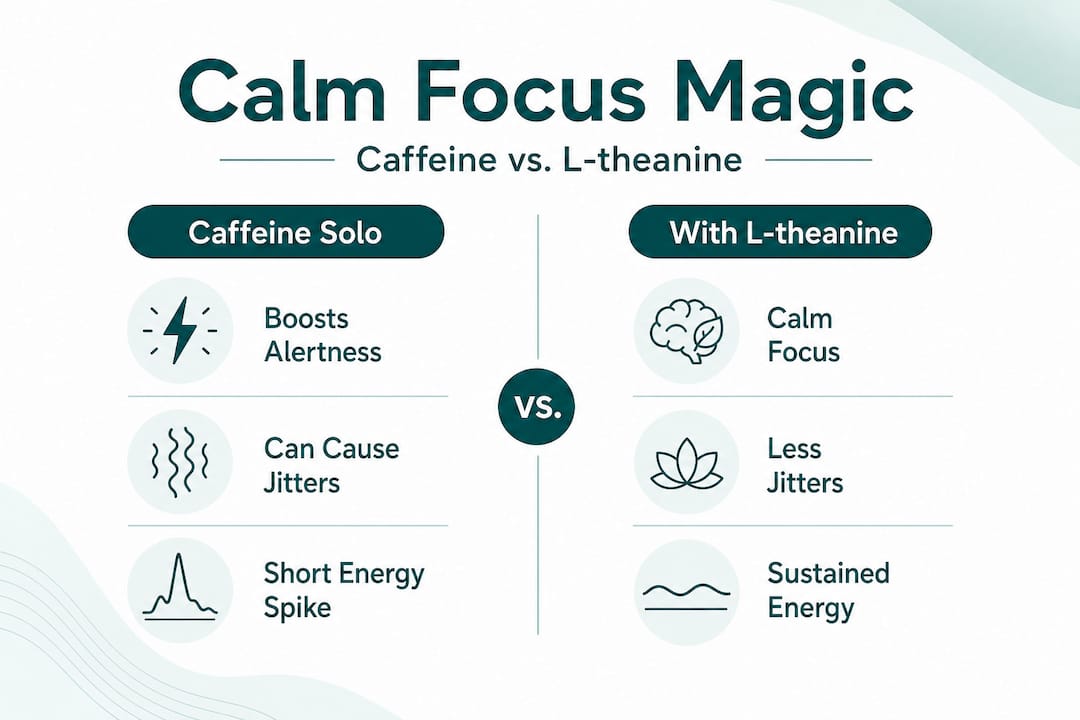
Caffeine alone blocks adenosine receptors, the receptors responsible for making you feel tired. That’s why it works. But it also raises cortisol, increases heart rate, and can trigger anxiety or jitteriness, especially at higher doses or when you’re already sleep-deprived. L-theanine steps in and modulates those side effects while amplifying the benefits.
The combination is more than the sum of its parts. That’s not marketing language. That’s what the clinical data shows.
How the synergy works, step by step
-
Caffeine blocks adenosine receptors, reducing fatigue signals and increasing alertness
-
L-theanine increases alpha wave activity, smoothing out the sharp stimulatory edge of caffeine
-
Together, they improve selective attention, the ability to focus on what matters and filter out distractions
-
Reaction time improves beyond caffeine alone, with faster, more accurate responses on cognitive tasks
-
Mood and motivation stabilize, reducing the anxiety spike that often accompanies high caffeine intake
A rigorous double-blind, placebo-controlled crossover study found that 200mg L-theanine combined with 160mg caffeine improved hit rate, discriminability, and reaction time by an additional 38ms, along with measurable changes in P3b ERP (an electrophysiological marker of attentional processing) in sleep-deprived adults (n=37). That’s not a small effect. A 38ms improvement in reaction time is the difference between catching an error and missing it.
Pro Tip: If you’re pulling a long study session or working through a demanding project, the combination of l-theanine and caffeine isn’t just more comfortable than caffeine alone. It’s measurably more effective. Aim for roughly a 2:1 ratio of l-theanine to caffeine for the smoothest results.
| Effect | Caffeine alone | L-theanine alone | Combined |
|---|---|---|---|
| Alertness | High | Mild | High |
| Anxiety/jitters | Often elevated | Reduced | Minimized |
| Selective attention | Moderate improvement | Moderate improvement | Strong improvement |
| Reaction time | Improved | Slightly improved | Improved by additional 38ms |
| Alpha wave activity | No significant change | Significantly increased | Increased |
| Crash risk | High | None | Low |
The comparison makes it clear. Neither compound alone delivers what the combination does. You can explore matcha vs coffee for focus in more detail, and if you’ve been struggling with the afternoon slump, understanding how to avoid caffeine crashes is a smart next step.
Safety, tolerance, and everyday use: What does the research show?
With synergy clarified, it’s essential to address how to use these compounds safely and intelligently in your daily routine.
One of the most reassuring things about l-theanine is its safety profile. It’s not a synthetic stimulant. It’s not a nootropic stack with unknown long-term effects. It’s a naturally occurring amino acid with a well-documented record of safe use.
According to a comprehensive wellness safety report, the FDA recognizes l-theanine as GRAS (Generally Recognized As Safe) up to 250mg per serving, and both EFSA and the FDA acknowledge no toxicity at doses up to 1200mg daily in long-term use. That’s a wide safety margin for everyday consumers.
Key safety and usage guidelines
-
Standard effective dose: 100–200mg per serving, often paired with 50–100mg caffeine
-
Maximum recognized safe dose: 250mg per serving (FDA GRAS)
-
Long-term safety ceiling: Up to 1200mg daily with no toxicity reported
-
Onset time: Effects on attention and visual processing typically appear within 30–60 minutes
-
Best timing: Take with or shortly before a focused work session for peak effect
-
Who should be cautious: People on blood pressure medications or those sensitive to amino acid supplements should check with a healthcare provider first
Tolerance is a real consideration, particularly for caffeine. L-theanine itself doesn’t appear to cause significant tolerance buildup, but the caffeine it’s paired with does. Over time, your adenosine receptors upregulate in response to consistent caffeine exposure, meaning you need more caffeine to get the same effect.
Pro Tip: Cycle your caffeine intake. Five days on, two days off is a practical rhythm that keeps your sensitivity sharp. On rest days, l-theanine alone can still support calm focus without the stimulation. Herbal teas or low-caffeine options give you the ritual without the tolerance hit.
Staying informed about energy drink trends can also help you make smarter choices as the functional beverage market evolves. And if stress is part of your daily equation, understanding how green tea balances cortisol adds another layer to why this combination works so well for high-pressure lifestyles.
Popular beverage options and how to make the most of l-theanine magic
Armed with dosing and safety knowledge, let’s turn to practical applications: the beverage options and routines that make l-theanine magic a reality.
Not all beverages deliver l-theanine equally. The form matters, and so does what it’s paired with. Research supports pairing l-theanine with green tea or matcha caffeine for natural synergy, with the recommendation to cycle caffeine intake to avoid tolerance over time.
Best beverage options for l-theanine benefits
-
Matcha: The highest natural source of l-theanine per serving. Ceremonial-grade matcha contains both caffeine and l-theanine in naturally balanced ratios, making it the gold standard for calm, focused energy.
-
Green tea: A gentler option with lower caffeine and meaningful l-theanine content. Great for afternoons or when you want focus without strong stimulation.
-
Functional energy drinks with matcha or green tea base: Look for zero sugar formulas that list l-theanine and natural caffeine sources - Lucent. Avoid drinks that rely on synthetic caffeine without any l-theanine to balance it.
-
L-theanine supplements: Capsules or powder allow precise dosing, but they lack the ritual and additional antioxidants found in whole tea-based beverages.
Routine strategies for professionals and students
-
Morning focus block: Start with a matcha-based drink 30 minutes before your most demanding work. The l-theanine and caffeine combination will be at peak effect when you need it most.
-
Midday reset: A cup of green tea around noon provides a gentle lift without disrupting sleep later. It also supports cortisol balance during the natural afternoon dip.
-
Pre-study session: Whether you’re writing a report or studying for an exam, timing your l-theanine and caffeine intake to match your session start gives you the sharpest window of focused attention.
-
Caffeine cutoff: Keep your last caffeinated drink before 2 p.m. to protect sleep quality. L-theanine without caffeine in the evening can still support calm alertness for evening reading or light work.
The biohacker community has been onto this for years, and the science keeps catching up. For those managing attention challenges, calm energy strategies built around l-theanine are gaining traction as a supportive tool alongside other approaches.
L-theanine magic: What most energy boosters miss
Most conversations about energy and focus start and end with stimulants. More caffeine. Stronger pre-workouts. Higher doses. The assumption is that more stimulation equals better performance. That assumption is wrong, and the research makes it clear.
What conventional energy products miss is the quality of the alert state they create. Jittery, anxious alertness is not the same as calm, focused alertness. Your prefrontal cortex, the part of your brain responsible for decision-making, planning, and sustained attention, actually performs worse under high stress and overstimulation. Flooding your system with stimulants without any counterbalance doesn’t sharpen your thinking. It narrows it.
L-theanine changes the equation by targeting the quality of your mental state, not just the intensity. That’s a fundamentally different approach. Calm alertness. Mental noise off. Locked in without the edge.
Here’s what we think most brands still get wrong: they treat energy as a quantity problem. How much caffeine can we pack in? How long can we keep someone awake? But for professionals and students, the goal isn’t to stay awake longer. It’s to think better, process faster, and sustain focus without burning out by midday.
The l-theanine and caffeine combination doesn’t just reduce side effects. It actually improves the cognitive outcome. That 38ms reaction time improvement in sleep-deprived adults isn’t a marginal gain. It’s meaningful. It’s the kind of edge that shows up in real work, real decisions, and real academic performance.
Sustainable performance is the goal. Not a spike. Not a crash. A steady, clear state that carries you through the day. That’s what natural focus boosters built around l-theanine and green tea can actually deliver, and it’s why we believe this approach is the future of functional beverages.
Ready to experience l-theanine magic?
If this article has shifted how you think about energy and focus, the next step is simple: try it for yourself.
Lucent’s matcha energy drinks are built around exactly this science. High-quality Japanese matcha delivers natural caffeine and l-theanine in a balanced ratio, with zero sugar and no synthetic stimulants. We’ve also added Vitamin B6, Vitamin B12, magnesium, and Vitamin C to support the full picture of mental performance and everyday wellbeing. Explore the brain nutrient benefits behind our formula, or try a range of flavors with our mixed pack to find what works best for your routine. Calm, clear, and sustained. That’s the Lucent difference.
Frequently asked questions
What is the safest daily dose of l-theanine for most adults?
L-theanine is FDA-recognized as safe up to 250mg per serving, with no toxicity reported at doses up to 1200mg daily in long-term use, making it suitable for consistent daily consumption.
How quickly does l-theanine work for focus and calm?
Research shows effects on attention and visual processing typically appear within 30 to 60 minutes after consumption, with a meta-analysis of 5 RCTs confirming measurable improvements in rapid visual information processing at those timeframes.
Does combining l-theanine with caffeine reduce jitters?
Yes. A double-blind RCT confirmed the combination improves selective attention and minimizes caffeine’s overstimulation effects, with reaction time improving by an additional 38ms compared to caffeine alone.
What are the best natural beverages with l-theanine?
Matcha and green tea are the top natural sources, offering l-theanine and caffeine together for synergistic cognitive effects. A beverage pairing report recommends pairing with green tea or matcha caffeine and cycling intake to avoid tolerance buildup over time.















