

Posted by Lucent Team

TL;DR:
- Green tea contains L-theanine, which helps regulate cortisol and reduces stress without overstimulating the nervous system.
- Consistent daily consumption enhances stress resilience and promotes calm alertness, supporting overall mental health.
Most people assume caffeine is caffeine. You drink it, cortisol spikes, stress climbs. But green tea breaks that assumption. Unlike coffee, green tea contains L-theanine, an amino acid that crosses the blood-brain barrier and actively modulates your stress response. The result is a drink that provides real alertness without sending your nervous system into overdrive. If you’ve been managing stress through willpower alone, understanding what green tea actually does to your cortisol levels could change the way you think about your daily routine.
Table of Contents
- What is cortisol and why does it matter?
- How green tea influences cortisol: The science
- Green tea, matcha, and L-theanine: What research reveals
- Potential risks, side effects, and safe use
- Practical ways to add green tea to your routine
- Why most people overlook the power of daily small habits
- Try a smarter way to stress less and focus more
- Frequently asked questions
Key Takeaways
| Point | Details |
|---|---|
| Green tea calms stress | Compounds like L-theanine in green tea naturally help buffer cortisol spikes and promote relaxation. |
| Consistent use matters | Daily green tea consumption is more effective for stress support than occasional use. |
| Safe in moderation | Moderate, regular green tea intake is safe for most adults when sourced from quality products. |
| L-theanine enhances focus | L-theanine boosts calm alertness, making green tea an ideal choice for natural focus and stress resilience. |
What is cortisol and why does it matter?
Cortisol is your body’s main stress hormone, produced by the adrenal glands and released into your bloodstream when your brain perceives a threat. That threat could be physical danger, a difficult conversation, a packed calendar, or three back-to-back meetings before lunch. Your body doesn’t always distinguish between them.
Cortisol is released via HPA axis (hypothalamic-pituitary-adrenal axis) overactivation, meaning your brain triggers a hormonal chain reaction that lands as tension, elevated heart rate, and sharpened alertness. Short term, that’s useful. It gets you moving. It sharpens your focus just enough to handle the immediate challenge.
The problem comes with chronic elevation. When cortisol stays high for days, weeks, or months, the consequences accumulate fast:
- Persistent fatigue even after full nights of sleep
- Reduced ability to concentrate and retain information
- Disrupted sleep cycles, especially lighter or fragmented sleep
- Suppressed immune function and slower recovery
- Increased cravings for high-sugar, high-fat foods
- Greater risk of anxiety and low mood
Learning more about cortisol and green tea reveals something important: the goal is never to eliminate cortisol. You need it. A flat cortisol curve means low motivation, brain fog, and sluggish mornings. The goal is balance. Cortisol should rise when needed and fall when the moment has passed. Green tea, it turns out, supports exactly that regulation.
How green tea influences cortisol: The science
Green tea’s impact on cortisol is not random. It comes from a precise combination of bioactive compounds, each working through different pathways to support your stress response and mental clarity.

The most studied is L-theanine. L-theanine crosses the blood-brain barrier to increase alpha brain waves, GABA, serotonin, and dopamine, promoting relaxation and reducing sympathetic nervous system activation, thereby attenuating HPA axis overactivation and cortisol release during stress. Alpha waves are the signature of relaxed alertness, the mental state you feel when you’re calm and focused at the same time. That state is valuable, and most people experience it too rarely.
The second key player is EGCG (epigallocatechin gallate), a potent antioxidant found in high concentrations in green tea and especially matcha. The EGCG and antioxidants in green tea reduce oxidative stress and systemic inflammation, both of which are amplified by elevated cortisol. It’s a complementary mechanism: L-theanine works on the nervous system, while EGCG supports the cellular environment.
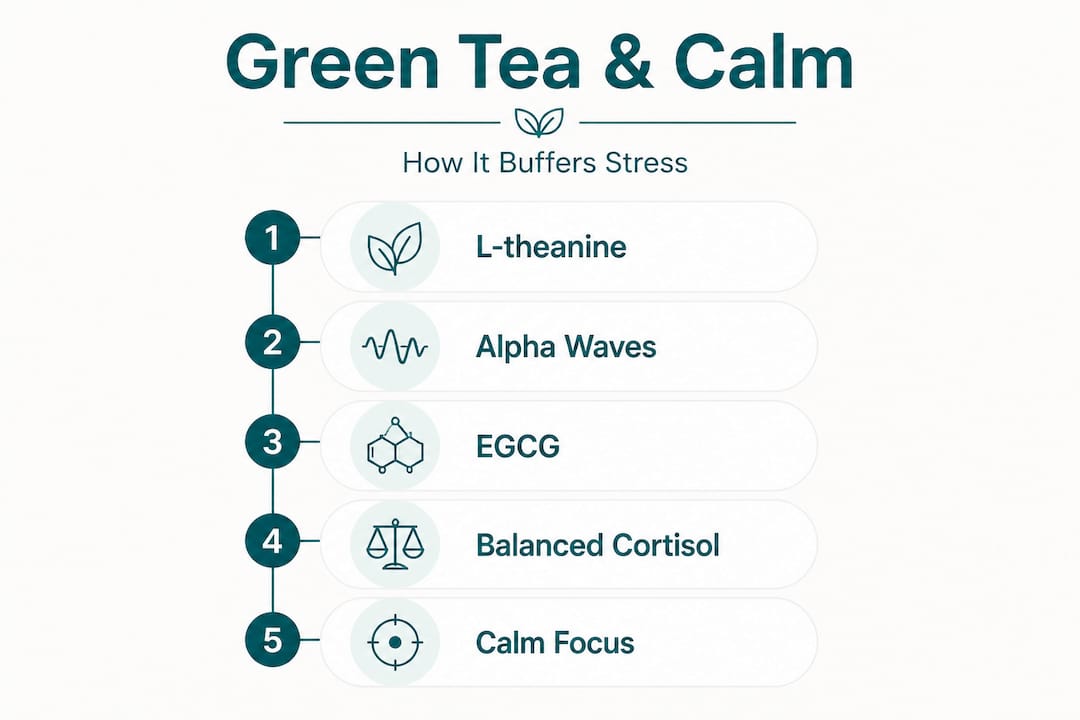
Here’s a breakdown of how the key compounds interact with your stress system:
| Compound | Source | Primary mechanism | Effect on cortisol |
|---|---|---|---|
| L-theanine | Green tea, matcha | Increases GABA, alpha waves, serotonin | Attenuates acute cortisol spikes |
| EGCG | Green tea, matcha | Antioxidant, anti-inflammatory | Reduces oxidative stress linked to cortisol |
| Caffeine | Green tea, matcha | Stimulates CNS, increases alertness | Mild cortisol rise, buffered by L-theanine |
| Catechins | Green tea | Modulate stress enzymes | Support HPA axis regulation |
“L-theanine modulates glutamate receptors and influences dopaminergic pathways, reducing anxiety-like behaviors. In humans, 200mg reduces salivary cortisol and sympathetic arousal during cognitive stress, pointing to real parasympathetic activation rather than mere sedation.”
This is what makes matcha especially interesting. It contains both caffeine and L-theanine in a natural ratio that tends to keep the stimulant effect of caffeine in check. You get the energy without the edge.
Green tea, matcha, and L-theanine: What research reveals
Mechanisms are useful, but real-world outcomes matter more to you. So what does the actual research show about how L-theanine and green tea affect stress, anxiety, and cortisol day to day?
The evidence is encouraging, with some important nuances. L-theanine buffers acute stress-induced cortisol spikes rather than lowering baseline hormone levels. This means it’s most effective when you’re facing a stressful moment: a presentation, a demanding conversation, a pressure-filled afternoon. It essentially softens the peak. The crash afterward is less dramatic, and the recovery is faster.
The effects are also more pronounced in people who start with higher baseline stress or anxiety. If you’re already calm and unstressed, L-theanine may feel subtle. If you carry tension through your days, the difference can be noticeably grounding.
One important limitation: L-theanine is not a treatment for clinical anxiety disorders or chronic stress conditions. It supports everyday stress resilience, which is still enormously valuable, but it’s not a medical intervention.
Here’s how it compares to other commonly used anti-stress approaches:
| Intervention | Mechanism | Cortisol effect | Practicality |
|---|---|---|---|
| L-theanine (green tea) | HPA axis modulation, GABA increase | Buffers acute spikes | High, easy daily use |
| Meditation | Nervous system regulation | Lowers baseline over time | Medium, requires practice |
| Magnesium | Adrenal support, GABA | Supports lower cortisol | High, easy supplementation |
| Prescription anxiolytics | GABA receptor binding | Significant reduction | Low, medical supervision needed |
| Exercise | Stress hormone metabolism | Reduces chronic levels | Medium, requires consistency |
Want to get the most from green tea for stress management? Follow these steps:
- Start your morning with green tea or matcha instead of coffee. This sets a calmer cortisol curve from the beginning of the day.
- Time your second serving before your most demanding task. L-theanine reaches peak plasma concentration roughly 30 to 45 minutes after consumption.
- Choose high-quality matcha for a higher ratio of L-theanine to caffeine compared to standard green tea bags.
- Drink consistently, not occasionally. The stress-buffering effects compound over time with regular use, especially if you carry higher baseline tension.
- Avoid green tea late in the evening. Caffeine sensitivity varies, and even moderate amounts can disrupt sleep quality for some people.
Explore the calming energy effects that come from pairing L-theanine and caffeine, and how this duo supports sustained attention. You can also read more about focus and green tea to understand why this combination outperforms caffeine alone for mental performance.
Pro Tip: Layer your green tea habit with a simple breathing routine. Even two minutes of slow diaphragmatic breathing before or after your matcha amplifies the parasympathetic shift that L-theanine initiates, deepening the sense of calm clarity.
Potential risks, side effects, and safe use
Honesty matters here. Green tea is one of the most thoroughly studied beverages in the world, and its safety profile is strong. But that doesn’t mean every form or dose is equivalent.
High-dose green tea extracts are linked to rare cases of hepatotoxicity (liver stress), while moderate beverage consumption is considered safe for the vast majority of adults. This is a critical distinction. Drinking two to four cups of quality green tea or matcha daily is very different from taking concentrated extract supplements in high doses.
Here’s what to keep in mind for safe, effective use:
- Stick to beverage form rather than high-concentration extract supplements unless under medical guidance.
- Choose quality sources. Matcha, particularly ceremonial grade from Japan, tends to be lower in contaminants and higher in beneficial compounds.
- Be mindful of caffeine sensitivity. Green tea contains less caffeine than coffee, but sensitive individuals may still notice mild restlessness at high daily volumes.
- Monitor for digestive sensitivity. Some people experience mild nausea when drinking green tea on an empty stomach. Pairing it with food resolves this for most.
- Pregnant women and those with liver conditions should consult their doctor before increasing green tea intake significantly.
- Medications: Green tea can interact with certain blood thinners and stimulant medications. If you’re on prescription drugs, check with your healthcare provider.
People who are building biohacker green tea routines often find that optimizing for quality and consistency delivers better results than chasing higher doses. For further reading on how matcha’s natural compounds support overall wellness, matcha benefits extend beyond just stress management into skin health and antioxidant protection.
Pro Tip: More is not better here. Two to three servings of quality green tea or matcha daily gives you consistent access to L-theanine and EGCG without pushing caffeine intake into territory that could backfire on your stress goals.
Practical ways to add green tea to your routine
Knowing the science only helps if you can actually build the habit. Consistency is what drives real results. Consistent daily use of green tea shows the most pronounced effects, especially in those with higher baseline anxiety or stress. Sporadic consumption gives you a fraction of the benefit.
Making green tea a reliable part of your day doesn’t require a complicated ritual. Here’s a simple framework:
- Replace your first coffee of the day with matcha. You get alertness from caffeine plus L-theanine’s smoothing effect right from the start.
- Build a midday reset with green tea. A cup around noon or early afternoon supports focus for the second half of your day without disrupting evening sleep.
- Use functional green tea drinks for convenience when you’re traveling, commuting, or away from your kitchen. Zero-sugar, matcha-based energy drinks can deliver consistent L-theanine and caffeine without preparation time.
- Pair your green tea moment with a short mindful break. Even five minutes away from screens, combined with your matcha, creates a compounded reset that’s greater than either practice alone.
- Track your stress signals over two to three weeks. Energy stability, sleep quality, and afternoon slumps are useful markers. Most people notice a real shift within ten to fourteen days of consistent daily use.
If you want to sustain energy naturally without the typical 3pm crash, green tea fits cleanly into that strategy. It’s also worth exploring coffee alternatives for energy if you’re ready to reduce your dependency on high-caffeine options that amplify rather than soften your cortisol response.
Why most people overlook the power of daily small habits
Here’s the honest truth: most people searching for stress solutions want a transformation, not a practice. They want the hack that fixes cortisol in a week. And because green tea is familiar, accessible, and undramatic, it gets dismissed. Why drink matcha every day when there’s a new supplement promising to reset your HPA axis in 72 hours?
The answer is simple. Those quick fixes rarely work, and the data on green tea is real. But the data only applies when the behavior is consistent. L-theanine doesn’t accumulate in your system like a medication. It shows up when you need it, buffers the cortisol spike, and supports the recovery. Every day. Quietly.
What actually changes with daily green tea isn’t just cortisol in the moment. It’s your relationship with your own stress response. You start to associate your matcha ritual with calm. The habit itself becomes a cue for your nervous system to downshift. That’s behavioral conditioning working in your favor, and it’s something no single-dose supplement can replicate.
“The ritual of daily green tea isn’t just biochemistry. It’s a signal you send your nervous system, repeated until it becomes automatic. That’s where the real stress resilience lives.”
Most wellness trends are optimized for novelty, not results. Green tea is the opposite. It’s quiet, consistent, and grounded in decades of solid research. If you want sustaining energy without crashes, the answer isn’t a stronger stimulant. It’s a smarter daily rhythm, and green tea supports that rhythm better than almost anything else in your cup.
Try a smarter way to stress less and focus more
You now understand the science. You know why L-theanine buffers cortisol spikes, how EGCG supports your stress response at a cellular level, and how consistency turns a daily cup of matcha into a genuine tool for mental resilience. The next question is practical: how do you make this easy enough to actually stick to?
That’s exactly what we built Lucent for. Our zero-sugar, matcha-based drinks deliver a consistent, measured dose of L-theanine and natural caffeine in every can, alongside Vitamin B6, B12, magnesium, and Vitamin C. No sugar spikes. No jittery edge. Just the calm, focused energy that matcha was always meant to provide. If you want to see how the full formula works for stress, focus, and sustained performance, explore the benefits of Lucent matcha and find the version of daily green tea that actually fits your life.
Frequently asked questions
Does green tea actually lower cortisol?
Green tea, especially due to its L-theanine content, helps buffer acute rises in cortisol during stress rather than lowering baseline hormone levels. Think of it as smoothing the peaks rather than flattening the curve entirely.
Is drinking green tea every day safe?
Yes, moderate green tea consumption is considered very safe for most healthy adults. Rare risks are linked to high-dose extracts rather than standard beverage consumption.
How much L-theanine should I get from green tea for stress?
Research points to around 200 mg of L-theanine as an effective dose for stress reduction, where 200mg reduces salivary cortisol and sympathetic arousal during cognitive stress. High-quality ceremonial matcha delivers a meaningfully higher L-theanine content per serving than standard green tea bags.
Is green tea better than coffee for managing stress?
Green tea’s natural pairing of L-theanine and mild caffeine tends to produce calmer, steadier alertness compared to coffee’s sharper cortisol activation. If stress management is a priority, green tea’s biochemistry is genuinely better suited to the goal.
Recommended
- How green tea balances cortisol for stress relief and focus – Lucent
- How Green Tea Improves Focus and Mental Clarity – Lucent
- Why Biohackers Use Green Tea for Focus and Energy – Lucent
- Healthy alternatives to coffee: Natural energy boosts for focus – Lucent
- Why Prioritize Relaxation: 30% Cortisol Drop Boosts Health – Lunix















